BDSM: A Beginner’s Guide to Consensual Erotic Violence
I'm ringing in the new year with a kinky collaboration for Rewire News Group, a national, nonprofit media organization exclusively dedicated to reporting on reproductive and sexual health, rights and justice.
If your New Year’s resolution is to expand your sexual horizons in 2026, then BDSM may be for you.
Perhaps streaming the steamy hit romance Heated Rivalry on HBO has piqued your interest in exploring the subtle sub/dom dynamic of hockey babes Shane Hollander and Ilya Rozanov. Maybe you’ve been reading a romantasy like Sarah J. Maas’ A Court of Thorns and Roses series—with its explicit scenes of abduction and rough sex—and feeling naughty.
Human sexuality has long included elements of physical aggression and consensual erotic violence.
“No human society has been found in which violence is absent from sexual relations,” writes psychoanalyst Darian Leader in his book Is It Ever Just Sex?
Citing several foundational surveys on human sexuality across cultures, Leader concludes: “The word ‘force’ is the single most common verb to describe sexual acts.” Even the ancient Hindu text the Kama Sutra describes several forms of erotic violence.
All this consensual violence and roleplay can sound ingriguing—and intimidating. So I’ve compiled a handy guide to BDSM for beginners, based on expert advice and my own experiences.
Step 1: Figure out what you like
Many people associate kink and BDSM with taboo—as some kind of maladaptive response to trauma. But that’s not necessarily the case, said Nora Gross, a licensed therapist in California who studied BDSM and kink in graduate school.
Full disclosure: Gross is my friend. She’s also an expert on this subject, so I called her to gain some insight on why people get into violent sex in the first place.
“First of all, there doesn’t have to be a dark origin story,” Gross told me. “You can like what you like and it doesn’t necessarily mean you experienced something traumatic.”
In other words, it’s OK to want to add something new into your sex life. To figure out what might meet that need, Gross suggested getting started by “microdosing” kinky, sex-positive creators online.
Lina Dune is one such sexpert. The creator of Ask A Sub—a podcast, newsletter, and Discord community—suggests wading into BDSM slowly. As you trawl forums, watch videos, listen to stories, tune in to your body. Is something giving you a tingle or a tummy ache?
“You don’t need to be an expert on every single facet of [BDSM],” Dune says in one podcast episode, “But you do need to be an expert on yourself … you know what bad feels like for you … And at the same time, you know what good feels like for you.”
Remember: Negative reactions to any particular story of BDSM doesn’t mean the entire BDSM universe is closed to you. That queasy feeling might just be telling you to skip a specific act or context.
Step 2: Do your research
Evie Lupine’s YouTube series BDSM 101 demystifies topics like BDSM contracts, the ins and outs of sexual punishment, and what a female-led relationship is.
For bookworms, S&M 101: A Realistic Introduction, the New Topping Book, and New Bottoming Book are frequently cited on kink forums as useful how-to guidebooks. There’s also Hurts So Good: The Science and Culture of Pain on Purpose, if you’re interested in the why of what drives people towards sadomasochism.
Many people, including myself, see the 2002 movie Secretary as a romantic and healthy depiction of a dom/sub relationship.
Step 3: Find a safe play partner
Finding someone else to explore kink with you may seem paralyzingly daunting. It’s hard to know who you can trust to be your play partner in such intimate scenes—and no one wants to feel the imperious leers of normies judging your desires.
The sex educator and BDSM lifestyle expert Miss Angela Valentine suggests joining a space dedicated to connecting people who are interested in fetish, kink, and BDSM.
For her, it was Fetlife, the self-described “most popular social network for the BDSM, kink, and fetish community.” Fetlife is a place for likeminded people to find each other, talk about their interests and adventures in kinky sex, and attend munches—meet-ups between kinksters. Typically, these take place in public, “vanilla” settings like pubs or bars—not sex clubs.
Feeld is another dating app dedicated to creating “more inclusive spaces online and IRL, where everyone can feel safe to express and explore gender, sexuality, and desire outside of existing blueprints.”
The app allows you to choose desire tags to help you find people with similar interests, like #BDSM, #Being a Brat, #Being dominant, or #Threeway. I recently used Feeld to meet a sexy Irish man who roleplayed some of my rather satisfying but taboo dom/sub dynamics over iMessage.
Miss Angela Valentine also recommends finding IRL lifestyle and kink clubs. Many cities, big and small, have spaces dedicated to kink and lifestyle.
Galleria Domain 2, in my hometown of Chicago, helps maintain a culture of safety by vetting its new members. Prospective inductees must attend a newcomer social and an informational session.
While BDSM may have a mainstream reputation for being full of scary, leatherclad freaks, my experience is that those immersed in the lifestyle have high sexual literacy and value consent, knowledge, and liberation. For beginners, these “pro kinksters”—Miss Angela Valentine’s term—can serve as BDSM mentors.
When negotiating and starting a BDSM dynamic with a new person, you can always ask for references from previous partners.
Step 4: Give it a go
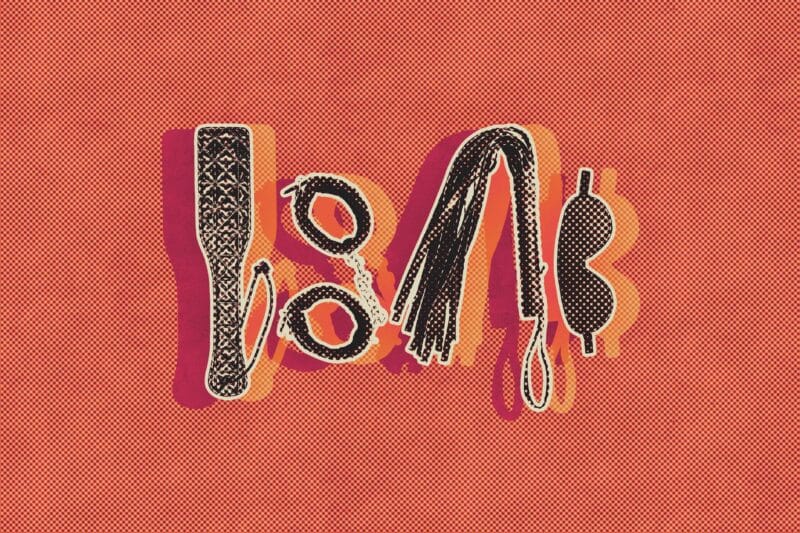
BDSM can start with something as simple as the classic blindfold and handcuffs set—toys that help you relinquish (or gain!) control to a partner.
Play with a simple spank on the rear end, using either your palm or a leather paddle. See how many strikes you can take before you feel the sweaty euphoria of subspace.
As you play, remember that negotiation, hard limits, and open communication are essential. Discuss what you want and what you’re curious about. Flag off-limits acts that you’re pretty sure will be triggering or unpleasant.
For instance, you might be interested in spanking, slapping, and other kinds of roughhousing—but definitely not interested in being cut or bleeding.
Once you’ve established trust and boundaries with your play partner, you can let loose within the scaffolding you’ve set up together. The wide world of latex vacbeds, human cages and electroshock toys awaits!
Step 5: Check in with yourself
Once you’ve given BDSM a go, check in on your feelings.
“Healthy practices demand that you’re connected to your body, your safety, your desires,” Gross said.
You may find that BDSM isn’t for you. Or you may find that consensual violence has unlocked something inside you.
Kink is play. Roleplaying necessitates imagination, and it is often kind of silly. Research shows most adults don’t have enough play in their lives, and that more play reduces cortisol levels, triggers the release of endorphins, and sharpens mental acuity.
Playing is particularly biochemically curative if you’re neurodivergent.
Autistic people who have sensory issues might experience the sort of light, feathery touch that is normalized in vanilla sex as extremely unpleasant. The heavy touch experienced while engaging in impact play—like spanking or slapping, etc—could feel much more pleasurable.
Meanwhile, accessing sub space and dom space can put your mind into a flow state. As many Reddit users will attest, it is essentially a meditating practice, which is medicinal for people who have ADHD.
There’s even some evidence that BDSM practices can be therapeutic for trauma survivors, Gross said. Research on this topic is limited. But the act of reclaiming the feeling of objectification that may have happened during moments of trauma, especially within the safe “container” of a BDSM scene, is “transformative for people who have experienced assault or trauma of all different kinds,” Gross said.
Whatever your reason for considering BDSM, getting a little naughtier in 2026 could make your life a little nicer.